

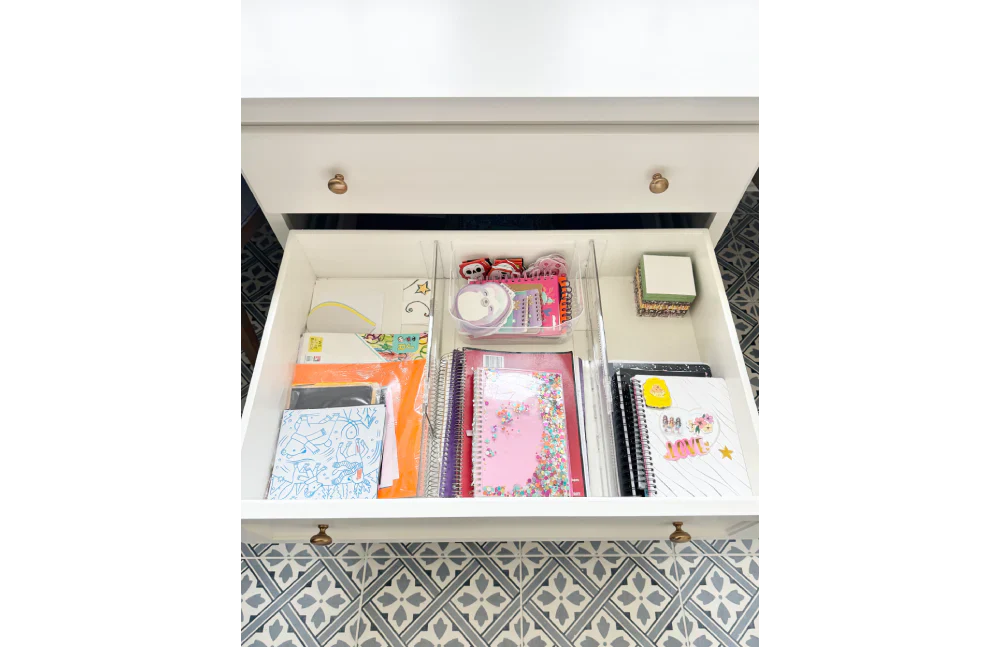
Every May, households across the country are inundated with stacks of worksheets, dioramas, self-portraits, participation certificates, and a million other items that kids of all ages produce throughout their school year. If you find it overwhelming, you are in good company! This is the season of milestones, and every milestone (even just moving from second to third grade) comes with the pressure to save everything.
We feel this deep, internal need to document every spark of genius or athletic prowess, often because we’re afraid that if we toss the paper, we’re tossing the memory. Let us remind you that memories live in your heart and mind, not in a box!
Keepsakes are a wonderful way to reconnect with those memories—but only if you are keeping what matters instead of everything you’ve ever smiled at.

Why Keepsakes Are a Family Sticking Point
Why is it so hard to throw away a pinch-pot that your kid doesn’t remember making and doesn’t want to keep? And why does there seem to be a force field around the recycle bin when you try to toss a stack of scribbles from when your youngest was learning to hold a marker?
In most cases, one or more emotions stand in the way. It’s normal to feel nostalgic when you see items from your children’s early years … and it can also be normal to have that wistful sense of missing the younger and snugglier versions of your beloved humans. Some of the clients we work with even talk about a feeling of grief or loss when sorting through items from their kids’ childhood.
In other cases, we keep things because we want to “legitimize” our kids’ hard work (or the fact that we were fascinating humans before we became parents!). We imagine a future biographer or grandchild marveling over a program listing a choir solo in 6th grade.
These complicated feelings are part of why we end up just keeping everything. We aren’t sure what will matter to our kids (or ourselves) after years or decades pass. The problem is that when you keep everything, it stops being treasure and becomes meaningless. It’s just one more crate to haul around and take up space.

Reframing Your Thinking: The Who and Why Test for Organizing Sentimental Items
Before you add another stack of graded spelling tests into a crate, asking yourself a couple of key questions can help you gain some clarity.
First, ask yourself who you are keeping the item for. If that crayon family portrait makes your heart swell every time you see it, it’s a parent keepsake. Save it with your treasures. If it’s a varsity letter, diploma, or something that you imagine will travel with your child into their future, save it with their treasures.
The second question to ask yourself is why you are keeping the item. We often see our clients keep an item only because of its age or they remember where they got it, not because it’s meaningful or valuable. Keeping a stuffed animal from your childhood even though you never liked it is not a good use of your space!
Practical Strategies for Decluttering Sentimental Items at Every Age
As our kids grow, the nature of what they bring home evolves from messy finger paintings to stackable academic achievements, and our systems need to grow right along with them.

The Early Years: The Art Avalanche
Toddlers and preschoolers are prolific artists. If you kept every “About Me” board, macaroni necklace, and crayon doodle, you’d need a warehouse! Here are a few keepsake decluttering tips for reducing the chaos at this stage:
- Create a holding tank for keepsakes (such as a pretty basket or crate under the bed) to delay your decision-making. You don’t need to decide the fate of a painting the moment it is handed to you. It’s okay to wait a few weeks or months until the initial excitement fades, and then you can more objectively decide whether to keep it or toss it.
- For 3D projects like cardboard castles and mobiles made of recycled items, snap a photo of your kid holding their creation. That photo will help you capture the creativity without collecting the dust.
- Use your refrigerator as a temporary gallery and follow the one-in, one-out rule. Every time a new piece of art comes home, it replaces the old one. The retired piece can be recycled, dropped in your holding tank for a later decision, or tucked into an envelope to be mailed to a lucky grandparent!
The Elementary Years: The Achievement Era
This is the age of participation certificates, spelling bees, and “Student of the Month” ribbons. Here are a couple of keepsake decluttering strategies to get you through it:
- Give each kid a sturdy crate for their elementary archive. By limiting the physical space from the start, you are naturally helping your kid keep their favorite things from each grade level, rather than everything they bring home. Some of our Bees swear by using one folder per grade level to keep it even simpler!
- At the end of every school year, look through the crate with your child, adding the most important pieces from this year and weeding out a few things from prior years that no longer feel relevant. This is not only a fun time to reminisce together, but also helps teach the valuable life skill of curating what you keep.

The Teenage Years: High School and Graduation
Between band programs, softball rosters, and prom tickets, the paper trail becomes a mountain! We have a couple of things to try:
- Milestone events like graduation creates a massive influx of cards, Class of 2026 decorations, and other related items all at once. Put everything in a graduation holding box for a couple of months, and then once the emotional high of the ceremony has settled, you and your new grad will be in a better position to decide what’s worth long-term storage.
- As they approach adulthood, start helping your kid move official documents like a diploma, social security card, or passport into a fireproof and waterproof safe. These are the documents that they will need for the rest of their lives!

Twenty-Somethings and Beyond: The Hand-Off
Whether they go to college, start their professional lives, or move into their first apartment, there comes a time when the collections need to face their owner:
- Once your child has settled into their own home, it’s time for the great hand-off! Bring out those bins and help them decide what they actually want to move with them into the next chapter of their lives.
- Encourage them to photograph and digitize papers and other items that they want a record of without using space for the physical item. A cloud-based folder for “grade school memorabilia” is much easier to move from apartment to apartment than five heavy-duty crates of old notebooks and trophies.

The secret to preventing a keepsake pile-up is regular organizing and editing. Just because something goes into the keepsake box doesn’t mean it has a lifetime lease! Make sure you check your bins periodically, because as your kids grow, you’ll find it easier to let go of the “good” to make room for the “great.”
If you’re staring at a mountain of school year leftovers and feeling overwhelmed, don’t forget that you can give the Bees a buzz! We can help you sort through the sentimental layers, design a sustainable system for everyone’s keepsakes, and clear out the clutter so that you can focus on making new memories.


